
Delivering integrated change in live airport operations
Integrated programme delivery for operationally ready Airport Operations Centres
Pro-Tel provides Programme Management and Business Change expertise for complex, regulated airport environments where operational continuity must be protected throughout change.
Pro-Tel integrates People, Process, Technology and Construction so that new operating models are understood, adopted, assured and ready to deliver measurable operational benefits.
Technology and construction alone do not create a functioning Airport Operations Centre. Delivery starts with the operational need, the people affected and the processes that must work on day one.
Operational readiness
People, processes, technology and facilities evidenced as ready for day-one operation.
Stakeholder adoption
Clear roles, decision rights, engagement, communications, training and reinforcement.
Integrated assurance
Risks, assumptions, issues, dependencies, decisions and readiness evidence managed as one picture.
Benefits realisation
Outcomes translated into measurable benefits with defined ownership, baselines and review points.
Business Change first – design around how the airport needs to operate
Successful Airport Operations Centre delivery depends on integrating four critical dimensions of change. When they work together, the operating model can function as one.
PEOPLELeadership, engagement, roles, communications and adoption.
PROCESSOperating model, procedures, decisions and service integration.
TECHNOLOGYRequirements, integration, testing and support focused on outcomes.
CONSTRUCTIONFacilities, phasing, commissioning and safe handover.
How integrated APOC delivery is managed
Integrated planning
Programme planning across People, Process, Technology and Construction with dependencies and readiness managed across the whole delivery system.
Business Change
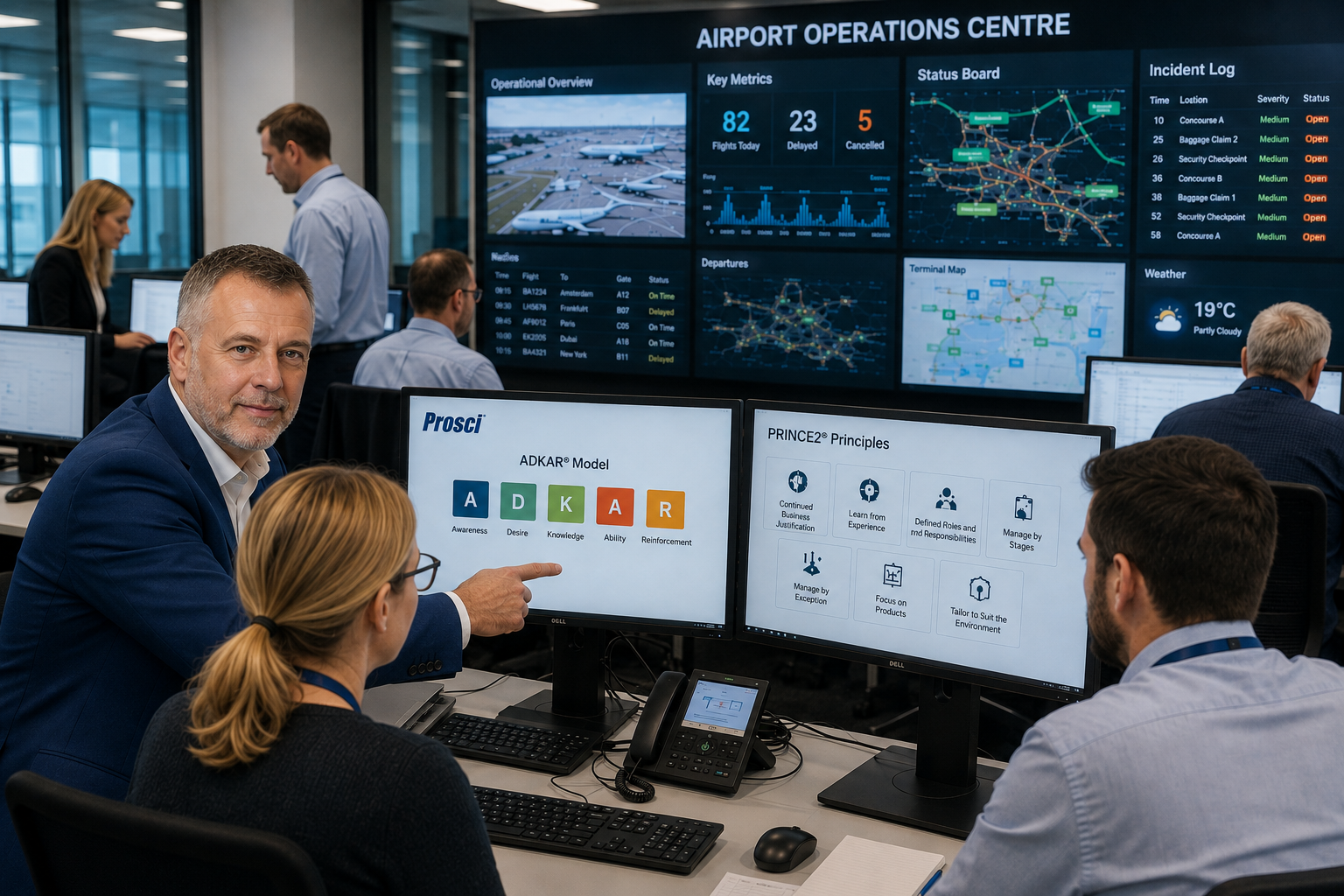
Prosci ADKAR to move stakeholders from awareness through adoption and reinforcement.
Stakeholder engagement
Mapping, engagement, communications and readiness ownership across airport teams, airlines, handlers and suppliers.
Governance & RAIDO
Governance, RAIDO, decision support and early escalation of material risks, assumptions, issues and dependencies.
Readiness & transition
Operational readiness, proving, transition, cutover and stabilisation planning.
Benefits realisation
Outcome → Benefit → Measure → Owner → Baseline → Review.
A practical sequence for operational transformation
Clarify the need, outcomes and scope.
Design the operating model and solution.
Mobilise the team, plan and engage.
Integrate people, process, technology and facilities.
Test, rehearse and prove the operating model.
Transition to live operation safely and confidently.
Stabilise operations and embed new ways of working.
Measure, review and realise the intended benefits.
Operational readiness is evidenced, not assumed
People
Roles understood, engaged, trained and capability demonstrated.
Process
Procedures agreed, interfaces understood and escalation routes defined.
Technology
Systems integrated, tested, supported and proven against scenarios.
Construction
Facilities commissioned, handed over and safely occupiable.
Governance
Risks, assumptions, issues, dependencies and decisions controlled with ownership.
Operational proving
Scenarios, exercises and transition activities prove the complete system.
Simplify.
Automate.
Standardise
Establish the operational baseline, ownership, decision rights and consistent ways of working.
Simplify
Remove avoidable complexity, clarify decisions and streamline hand-offs.
Automate
Introduce technology only where the process is understood and automation creates measurable operational benefit.
APOC implementation is managed as an integrated business change rather than a collection of individual workstreams. Risks and dependencies are surfaced early, decisions are evidence-led, and readiness is assessed across people, process, technology and the physical environment.